


Modern aerospace engineering demands materials that deliver exceptional structural integrity while remaining invisible to electromagnetic signals. For radar radome structures on commercial airliners, military jets, unmanned aerial vehicles (UAVs), and satellite communication terminals, achieving this balance is non-negotiable. A radome must act as a protective shield against aerodynamic forces, extreme temperature fluctuations, ice, and bird strikes, all while allowing microwave signals to pass through with near-zero distortion.
Aerospace grade quartz fiber yarn has emerged as the Gold Standard reinforcement material for high-performance radome composite manufacturing. Designed to meet strict dielectric, thermal, and mechanical requirements, high-purity quartz fiber enables engineering teams to maximize signal transmission accuracy without compromising structural durability.
Dielectric Performance and Microwave Signal Transparency
The primary function of any aircraft radar radome is electromagnetic window transparency. Standard reinforcement fibers, such as carbon fiber or high-strength glass fiber, often introduce signal attenuation, refractive index mismatch, or unwanted reflection, which degrades radar range and target resolution.
Quartz fiber yarn addresses these challenges through its exceptionally low dielectric constant and minimal loss tangent. Because it is manufactured from high-purity silica ($SiO_2$), quartz fiber maintains stable dielectric properties across a wide frequency spectrum—from high-frequency X-band and Ku-band radar systems to ultra-high-frequency Ka-band satellite communication links.
By utilizing quartz fiber reinforcement in the composite skin, engineers can achieve high signal transmission efficiency. This minimizes signal loss, reduces ghosting, and allows onboard radar systems to operate at peak detection capability under all weather conditions.
Thermal Stability in Extreme Flight Environments
Aerospace radomes face severe thermal environments, ranging from sub-zero temperatures at high cruise altitudes to intense aerodynamic frictional heating during high-speed or supersonic flight. Thermal expansion or phase transformations within the radome composite can introduce internal stresses, micro-cracking, and signal distortion over time.
Quartz fiber yarn possesses an extraordinarily low coefficient of thermal expansion (CTE) and remarkable thermal resistance. It maintains its structural strength and dielectric consistency at continuous operating temperatures well above typical resin limits.
When paired with advanced cyanate ester, polyimide, or high-temperature epoxy resin systems, quartz fiber composite structures maintain dimensional stability. This prevents the radome shell from delaminating, warping, or altering its dielectric thickness, ensuring that microwave signal propagation remains precise throughout the aircraft’s operational lifespan.
Mechanical Strength and Impact Resistance for Structural Shells
While electromagnetic performance is critical, a radome remains a vital structural component exposed to severe mechanical loads. During flight, radomes must withstand rain erosion, hail impact, bird strikes, and dynamic aerodynamic pressures without cracking or collapsing.
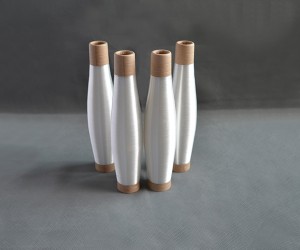
High-purity quartz fiber yarn offers tensile strength and impact resistance superior to standard E-glass and comparable to high-performance S-glass, while providing significantly better dielectric characteristics. The fine filament configuration of high-grade quartz yarn allows for precise weaving into multi-axis fabrics, prepregs, and 3D braided structures.
This high-strength fiber matrix distributes localized impact energy efficiently across the composite structure, preventing catastrophic propagation of micro-fractures and maintaining the structural boundary of the radome assembly.
Manufacturing Processability and Quality Control Demands
Fabricating an aerospace radome requires strict process control to ensure consistent wall thickness, void-free resin wet-out, and uniform fiber distribution. Any variance in resin content or fiber orientation can alter the local dielectric constant, causing signal refraction and boresight error.
Quartz fiber yarn provides exceptional flexibility and handling characteristics during textile processing. It accepts various resin chemistries smoothly, whether processed through traditional autoclave prepreg molding, resin transfer molding (RTM), or automated fiber placement (AFP).
To meet stringent aviation airworthiness standards, every batch of aerospace-grade quartz fiber yarn must undergo rigorous testing for chemical purity, filament diameter consistency, tensile yield, and moisture content, ensuring repeatable performance from the lab to the production line.
Trusted Material Supply: Partnering with SHENJIU
Securing a reliable supplier capable of delivering consistent, high-purity quartz fiber yarn is essential for aerospace manufacturers and defense contractors. SHENJIU has established itself as a dedicated manufacturer specializing in high-performance quartz fiber products tailored for demanding aerospace applications.
SHENJIU focuses on strict raw material selection and advanced fiber-drawing technology to produce quartz fiber yarns with high silica purity, precise filament uniformity, and excellent mechanical properties. Their product line includes continuous yarns, twisted yarns, and specialized sizing formulations designed for compatibility with high-temperature aerospace resin systems.
By working closely with composite engineers, SHENJIU provides customized yarn specifications that streamline the weaving, prepregging, and molding processes. For aerospace projects requiring reliable signal transparency, thermal resistance, and long-term durability, SHENJIU offers a dependable material foundation for next-generation radome structures.
Optimizing Next-Generation Radar Radome Design
As aviation radar and communication systems move toward higher frequency bands and phased-array technology, the demands placed on composite radomes will continue to increase. Choosing aerospace grade quartz fiber yarn ensures that your radome structures achieve optimal microwave signal efficiency, mechanical toughness, and thermal endurance.
Through careful selection of yarn specifications, resin systems, and manufacturing techniques—supported by experienced material suppliers like SHENJIU—aerospace engineers can build lightweight, high-reliability radomes that keep aircraft safe and connected in every flight envelope.
Aug-04-2026