


Quartz fiber cloth is widely used in high-temperature industrial environments where long-term thermal stability and insulation performance are essential. In applications such as furnace systems, aerospace thermal protection, and advanced industrial equipment, materials are often exposed to continuous ultra-high temperature conditions. Under these demanding environments, quartz fiber cloth maintains stable structural integrity and reliable insulation behavior, making it an important material for modern engineering systems.
high temperature stability in continuous working environments
In real industrial operations, materials are rarely exposed to short-term heat; instead, they often operate under continuous high-temperature conditions for long cycles. This requires insulation materials to maintain performance without deformation, shrinkage, or structural failure.
Quartz fiber cloth is engineered with high silica content, allowing it to retain stability even under sustained extreme heat. In furnace linings, thermal barriers, and heat shielding systems, it helps maintain consistent insulation performance, reducing heat loss and improving operational reliability.
This stability is especially important in systems that cannot frequently shut down, where consistent thermal behavior directly impacts production quality and system safety.
thermal insulation performance and energy efficiency value
The insulation capability of quartz fiber cloth is mainly derived from its fibrous structure and low thermal conductivity. The woven fiber network forms multiple air pockets, which significantly reduce heat transfer through conduction and convection.
In industrial environments, this structure helps reduce energy consumption by limiting unnecessary heat loss. As a result, heating systems can maintain target temperatures more efficiently, improving overall energy utilization.
In long-term operations, this contributes not only to stable performance but also to more controlled thermal conditions in production systems, which is essential for precision industrial processes.
structural reliability under thermal stress conditions
Another important advantage of quartz fiber cloth is its ability to maintain structural integrity under repeated or continuous thermal stress. Many materials tend to weaken or deform when exposed to prolonged high temperatures, but quartz fiber cloth remains stable due to its inorganic composition.
In practical applications such as furnace doors, expansion joints, and insulation layers, mechanical strength and flexibility are both required. Quartz fiber cloth provides a balance between these properties, ensuring that insulation systems remain functional even under vibration, thermal expansion, and mechanical load.
This makes it suitable for industrial systems that require long service life without frequent material replacement.
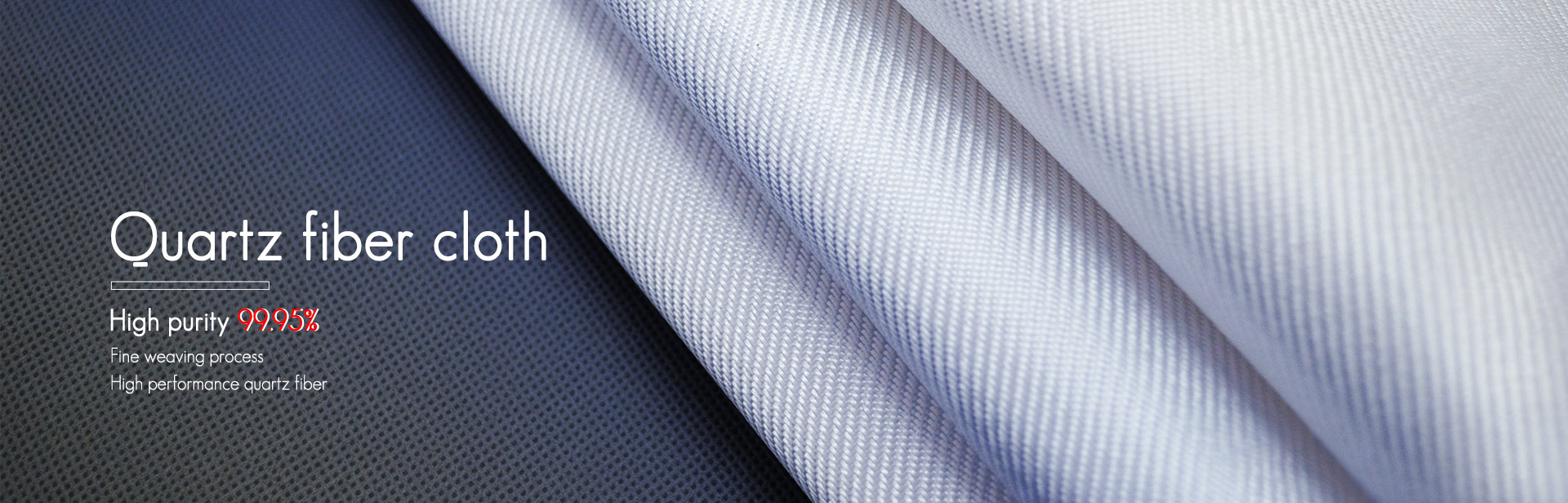
clean material characteristics for advanced applications
In high-precision industrial environments, material purity plays an important role in system performance. Quartz fiber cloth is valued for its low impurity content and stable chemical structure, which helps minimize contamination risks in sensitive thermal processes.
In real production environments, this stability supports consistent system operation and reduces interference from unwanted particles. This is particularly important in advanced manufacturing systems where thermal accuracy and material cleanliness must be strictly controlled.
application range in high temperature industries
Quartz fiber cloth is used across a wide range of high-temperature industrial applications. In furnace insulation systems, it acts as a thermal barrier that reduces energy loss. In aerospace systems, it provides heat shielding for structural components exposed to extreme conditions.
It is also widely used in sealing systems, wrapping insulation, and protective layering structures. Its flexibility allows it to be applied to irregular surfaces, making it suitable for customized engineering solutions.
These application scenarios highlight its versatility in both static and dynamic thermal environments.
processing flexibility and engineering integration
From a manufacturing perspective, quartz fiber cloth offers strong adaptability in processing and system integration. It can be cut, layered, and combined with other insulation materials to meet specific engineering requirements.
In many industrial designs, it is used as part of multi-layer insulation systems to achieve optimized thermal performance. Its flexibility allows engineers to integrate it into complex structures without compromising insulation efficiency.
This makes it suitable for both standard industrial equipment and customized high-performance systems.
SHENJIU professional support in quartz fiber materials
In high-temperature insulation applications, material consistency and supply reliability are essential. SHENJIU provides quartz fiber cloth solutions designed for stable performance under continuous ultra-high temperature conditions.
With a focus on material control and industrial application support, SHENJIU supplies products suitable for furnace systems, thermal protection layers, and advanced engineering environments. In practical use, this helps industrial users maintain consistent insulation performance while meeting demanding operational requirements.
Quartz fiber cloth demonstrates strong and stable insulation performance under continuous ultra-high temperature conditions due to its structural composition, thermal resistance, and mechanical stability. In real industrial environments, it contributes to energy efficiency, system reliability, and long-term operational stability.
With consistent material quality and application-oriented support from SHENJIU, quartz fiber cloth continues to play an important role in modern high-temperature engineering systems where durability and thermal stability are critical.
Jun-30-2026